ปริญญาโท โลกศาสตร์
หลักสูตรวิทยาศาสตรมหาบัณฑิต สาขาวิชาโลกศาสตร์
ชื่อหลักสูตร
- หลักสูตรวิทยาศาสตรมหาบัณฑิต สาขาวิชาโลกศาสตร์
- Master of Science Program in Earth Sciences
ชื่อปริญญา
- วิทยาศาสตรมหาบัณฑิต (วท.ม.)
- Master of Science (M.Sc.)
ปรัชญาของหลักสูตร
เป็นหลักสูตรวิทยาศาสตรมหาบัณฑิตระดับชาติที่เป็นแหล่งผลิตมหาบัณฑิต นักวิจัยและนักวิชาการที่มีความรอบรู้และเชี่ยวชาญด้านโลกศาสตร์ ที่สามารถปฏิบัติงานทางธรณีวิทยาสิ่งแวดล้อม ธรณีวิทยาประยุกต์ อุตุนิยมวิทยาอุทกวิทยาและอุทกธรณีวิทยา รวมทั้งศาสตร์ด้านอื่น ๆ ที่เกี่ยวข้องในสาขาโลกศาสตร์ อีกทั้งสามารถนำองค์ความรู้ที่มีมาประยุกติ์ใช้ในการบริหารจัดการทรัพยากรธรรมชาติ สิ่งแวดล้อมและพิบัติภัยได้อย่างเป็นระบบ พร้อมทั้งเป็นแหล่งความรู้และอ้างอิงทางวิชาการด้านโลกศาสตร์โดยมีแนวทางการพัฒนาการเรียนการสอนและการวิจัยที่สอดคล้องกับความต้องการของประเทศและนานาชาติอย่างมีคุณภาพและคุณธรรม
คุณลักษณะบัณฑิตที่พึงประสงค์
- มีความรู้ความสามารถในการคิด ปฏิบัติ และการประยุกต์หลักการของวิชาโลกศาสตร์เพื่อแก้ปัญหาได้
- สามารถดาเนินงานวิจัยด้านโลกศาสตร์ นาเสนอผลงานวิจัยและเขียนบทความวิจัยด้านโลกศาสตร์
- เป็นผู้มีคุณธรรม และรับผิดชอบต่อสังคม
คุณสมบัติของผู้เข้าศึกษา
- สาเร็จปริญญาวิทยาศาสตรบัณฑิต ปริญญาวิศวกรรมศาสตรบัณฑิต ปริญญาครุศาสตรบัณฑิต หรือปริญญาบัณฑิตอื่นๆ หรือเทียบเท่า ในสาขาที่เกี่ยวข้องกับด้านโลกศาสตร์ และ
- คุณสมบัติอื่นๆ เป็นไปตามประกาศซึ่งบัณฑิตวิทยาลัย จุฬาลงกรณ์มหาวิทยาลัย จะประกาศให้ทราบเป็นปีๆ ไป หรือคณะกรรมการบริหารหลักสูตรฯ พิจารณาแล้วเห็นสมควรให้มีสิทธิสมัครเข้าศึกษาได้
ระบบการศึกษา
ใช้ระบบการศึกษาแบบหน่วยกิต เป็นแบบทวิภาค ปีการศึกษาหนึ่งๆ แบ่งออกเป็น 2 ภาคการศึกษา คือ ภาคการศึกษาต้น และภาคการศึกษาปลาย และอาจมีภาคฤดูร้อนต่อจากภาคการศึกษาปลายอีก 1 ภาคก็ได้ ในภาคการศึกษาหนึ่งๆ ต้องมีระยะเวลาไม่น้อยกว่า 15 สัปดาห์ ส่วนภาคฤดูร้อนต้องมีระยะเวลาการศึกษาไม่น้อยกว่า 6 สัปดาห์ แต่ไม่เกิน 8 สัปดาห์ ทั้งนี้ต้องมีชั่วโมงเรียนของแต่ละรายวิชาเท่ากับชั่วโมงเรียนในภาคการศึกษา
ช่วงเวลารับสมัครนิสิตใหม่
ตามประกาศของบัณฑิตวิทยาลัย จุฬาลงกรณ์มหาวิทยาลัย โดยรับสมัครทั้งสองภาคการศึกษา
ภาคการศึกษาต้น: ประมาณเดือนเมษายน
ภาคการศึกษาปลาย: ประมาณเดือนกันยายน
ระยะเวลาการศึกษา
เป็นหลักสูตร 2 ปี โดยประกอบด้วย
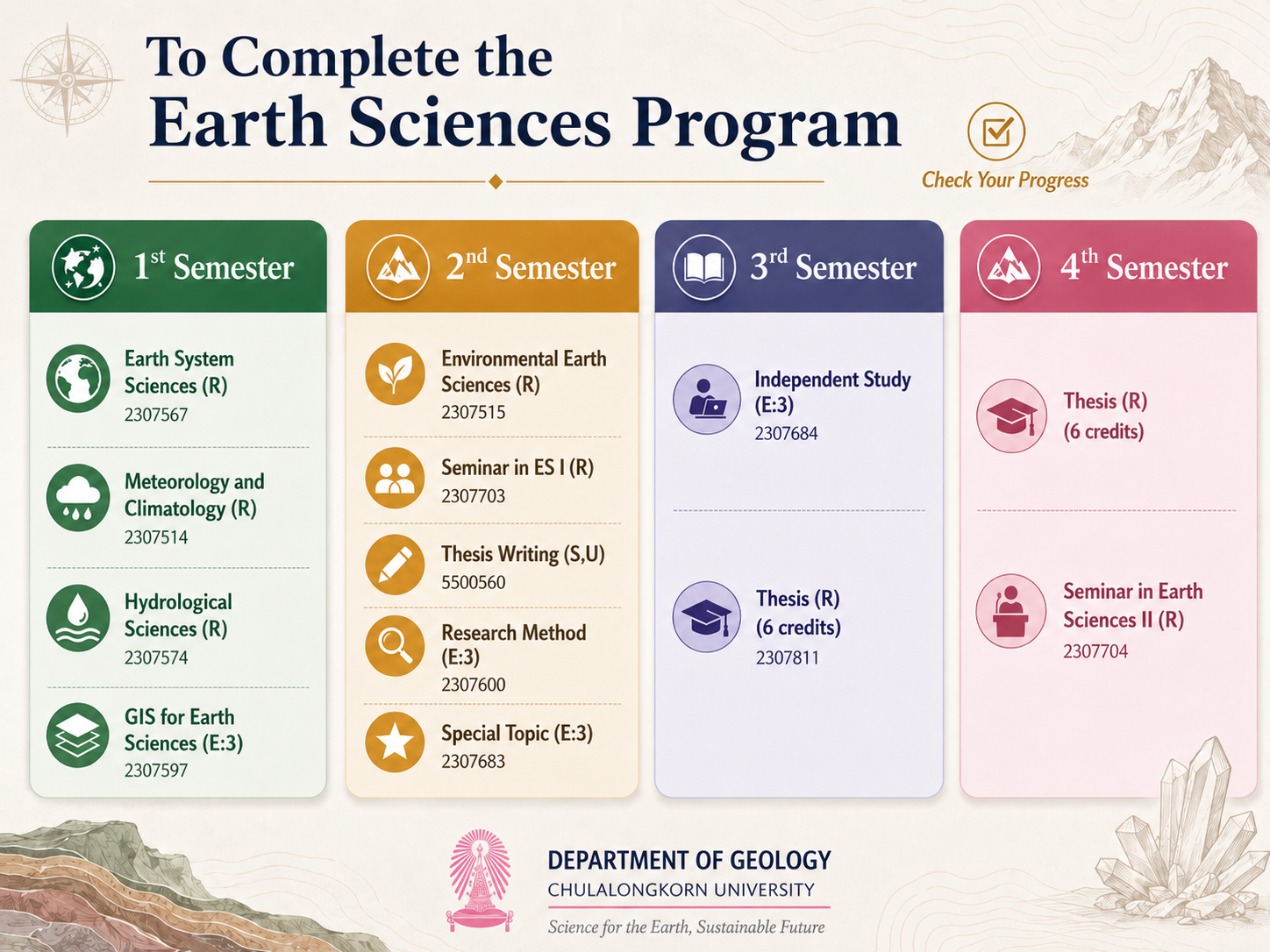
1) วิชาหลัก (บังคับ) 6 วิชา ได้แก่
- วิทยาศาสตร์ระบบโลก (Earth System Sciences (2307567)) ศีกษาเกี่ยวกับธรณีภาค กระบวนการต่างๆทั้งภายในและบนผิวโลก รวมถึงวัสดุต่างๆที่พบบนโลก
- อุตุนิยมวิทยาและภูมิอากาศวิทยา (Meteorology and Climatology) เนื้อหาเกี่ยวกับชั้นบรรยากาศ ปรากฎการณ์ต่างๆที่เกิดขึ้นในบรรยากาศและการเปลี่ยนแปลงของสภาพภูมิอากาศ
- วิทยาศาสตร์ทางอุทก (Hydrological Science) เน้นที่อุทกภาคและวัฎจักรของน้ำ ทั้งในบรรยากาศ การไหลเวียนของน้ำบนผิวดิน ได้แก่ มหาสมุทร แม่น้ำและแหล่งน้ำต่างๆ รวมถึงน้ำใต้ดิน
- โลกศาสตร์สิ่งแวดล้อม (Environmental Earth Sciences) ศึกษาวัฏจักรและระบบต่างๆ ของโลก การเคลื่อนถ่ายของพลังงานและสสารในบรรยากาศ ในอุทกภาค ธรณีภาคและชีวภาคของโลก ผลกระทบอันเกิดจากกระบวนการภายในและบนพื้นโลก ความจากัด การใช้สอย และการจัดการทรัพยากรประชากร ความมั่งคั่งของสังคม และผลกระทบต่อสิ่งแวดล้อม
- สัมมนาโลกศาสตร์ 1 และ 2 (Seminar in Earth Sciences I and II)
2) วิชาบังคับเลือก 2 วิชา ได้แก่ สารสนเทศน์ภูมิศาสตร์สำหรับธรณีศาสตร์ (GIS for Earth Sciences) และการเขียนเพื่องานวิจัย (Research Writing)
3) วิชาเลือกอื่นๆในหลักสูตรโลกศาสตร์ หรือในภาควิชาธรณีวิทยาตามแต่ที่อาจารย์ที่ปรึกษาวิทยานิพนธ์เห็นสมควร
นิสิตมีระยะเวลาการศึกษาไม่เกิน 4 ปีการศึกษา นับจากภาคการศึกษาแรกที่รับเข้าศึกษาในหลักสูตรฯ จนถึงภาคการศึกษาที่นิสิตสอบผ่านและดาเนินการครบถ้วนตามหลักสูตรฯ
การลงทะเบียนเรียน
นิสิตจะต้องลงทะเบียนเรียนในภาคการศึกษาหนึ่งๆ ไม่เกิน 15 หน่วยกิต ส่วนในภาคฤดูร้อนจะลงทะเบียนได้ไม่เกิน 6 หน่วยกิต หรือเป็นไปตามข้อบังคับจุฬาลงกรณ์มหาวิทยาลัยว่าด้วยการศึกษาใน ระดับบัณฑิตศึกษา
การสนับสนุนและการให้คำแนะนำนักศึกษา
หลักสูตรจัดปฐมนิเทศนิสิตใหม่ทุกปีการศึกษา เพื่อแนะนาและให้ข้อมูลเกี่ยวกับหลักสูตร กฎเกณฑ์ ระเบียบวิธีปฏิบัติต่างๆ จัดอาจารย์ที่ปรึกษาวิทยานิพนธ์ให้อย่างเหมาะสม ให้คาแนะนาในการเขียนวิทยานิพนธ์
อาชีพที่สามารถประกอบได้หลังสาเร็จการศึกษา
อาจารย์หรือครูในมหาวิทยาลัยหรือสถาบันการศึกษา นักวิชาการหรือนักวิจัยในหน่วยราชการหรือเอกชนเช่น กรมทรัพยากรธรณี กรมทรัพยากรธรณีและชายฝั่ง กรมทรัพยากรน้ำ กรมทรัพยากรน้ำบาดาล การไฟฟ้าฝ่ายผลิตแห่งประเทศไทย สถาบันส่งเสริมการสอนวิทยาศาสตร์ (สสวท) กรมอุตุนิยมวิทยา สานักฝนหลวงและการบินเกษตร กรมเชื้อเพลิงธรรมชาติ หน่วยงานสารวจและผลิตปิโตรเลียม หน่วยงานด้านสิ่งแวดล้อมและพิบัติภัย เป็นต้น
ติดต่อสอบถาม
รศ.ดร.ฐิติพรรณ อัศวินเจริญกิจ thitiphan.a@chula.ac.th โทร 02-218-5442
_______________________________________________________________________________________________________________________________________
Master of Science Program in Earth Sciences
Revised Curriculum 2023 (B.E. 2566)
Department of Geology, Faculty of Science
Chulalongkorn UniversityProgram Title
- Master of Science Program in Earth Sciences
Degree Awarded
- Master of Science (M.Sc.)
Program PhilosophyThe Master of Science Program in Earth Sciences is a nationally recognized graduate program committed to educating highly knowledgeable and skilled graduates, researchers, and academic professionals in the field of Earth sciences.The program prepares students to undertake professional and research work in environmental geology, applied geology, meteorology, hydrology, hydrogeology, and other related areas of Earth sciences. Graduates are equipped to apply scientific knowledge systematically to the management of natural resources, the environment, and natural hazards.The program also serves as a center of knowledge and an academic reference in Earth sciences. Its teaching and research activities are continuously developed to meet national and international needs while upholding high standards of academic quality, professional ethics, and social responsibility.
Admission RequirementsApplicants must:
- Hold a Bachelor of Science, Bachelor of Engineering, Bachelor of Education, or another bachelor’s degree or equivalent qualification in a discipline related to Earth sciences; andMeet any additional requirements specified in the annual admission announcement issued by the Graduate School, Chulalongkorn University, or be considered eligible for admission by the Program Administrative Committee.
Academic SystemThe program follows a credit-based semester system. Each academic year consists of two regular semesters:
- First semesterSecond semester
An optional summer session may be offered following the second semester.
Each regular semester must comprise no fewer than 15 weeks of study. The summer session must last between six and eight weeks, with the total instructional hours for each course equivalent to those provided during a regular semester.
Application Periods
Applications are accepted for both the first and second semesters in accordance with the official admission announcements of the Graduate School, Chulalongkorn University.
The approximate application periods are:
-
- First-semester admission: April
-
- Second-semester admission: September
Applicants are encouraged to consult the Graduate School’s official announcements for confirmed application dates and requirements.
Program Duration and Curriculum Structure
The program is designed to be completed within two academic years.
-
- Core Courses
Students are required to complete 6 core courses:
Earth System Sciences (2307567)
This course examines the lithosphere and the evolution of the Earth, beginning with the formation of the solar system and planets. Topics include the Earth’s internal and surface processes, planetary systems, and the materials that constitute the Earth.
Meteorology and Climatology (2307514)
This course covers the structure and properties of the atmosphere, atmospheric processes and phenomena, weather systems, climate patterns, and climate change.
Hydrological Science (2307574)
This course focuses on the hydrosphere and the hydrological cycle, including atmospheric water, surface-water movement, oceans, rivers, other water bodies, and groundwater systems.
Environmental Earth Sciences (2307515)
This course examines the cycles and interconnected systems of the Earth, including the transfer of energy and matter among the atmosphere, hydrosphere, geosphere, and biosphere.
It also addresses the environmental effects of internal and surface Earth processes, the limitations, utilization, and management of natural resources, and the relationships among population, societal development, resource consumption, and environmental impacts.
Seminar in Earth Sciences I (2307703)
Students develop academic communication skills through the review, analysis, discussion, and presentation of current research and emerging issues in Earth sciences.
Seminar in Earth Sciences II (2307704)
Students further strengthen their ability to critically evaluate scientific literature, communicate research findings, and participate effectively in professional and academic discussions.
-
- Elective Courses
Students are required to complete two prescribed elective courses:
-
- GIS for Earth Sciences (2307597)
-
- Research Methodology for Geosciences (2307600)
-
- Other Elective Courses
Students may select additional elective courses offered by the Earth Sciences Program or the Department of Geology, subject to the recommendations and approval of their thesis advisors.
Although the program is designed to be completed within two years, students must complete all program requirements within a maximum of four academic years, calculated from the first semester of enrollment until the semester in which all academic and graduation requirements are fulfilled.
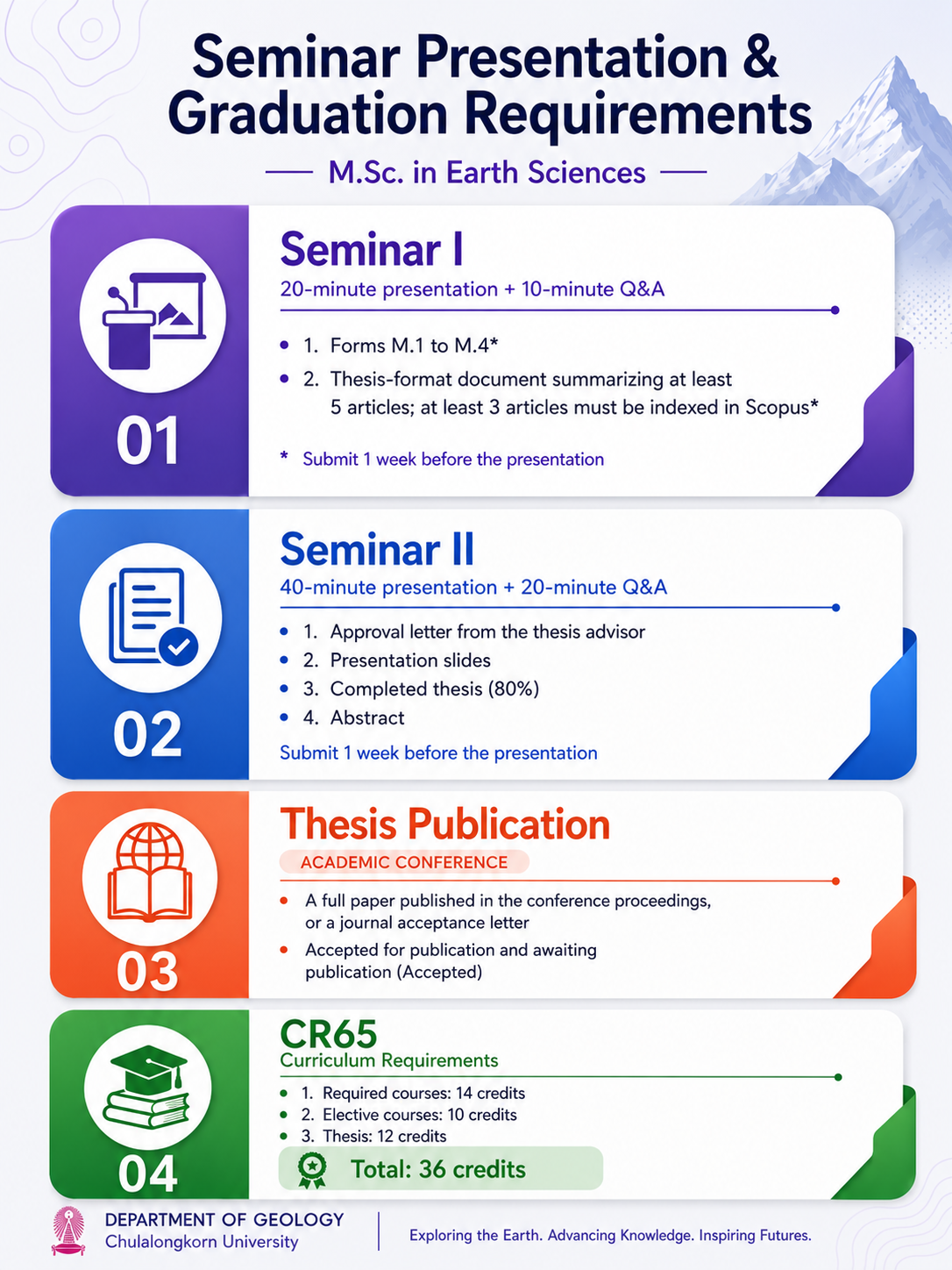
Details of Seminar I, Seminar II, and Graduation Requirements
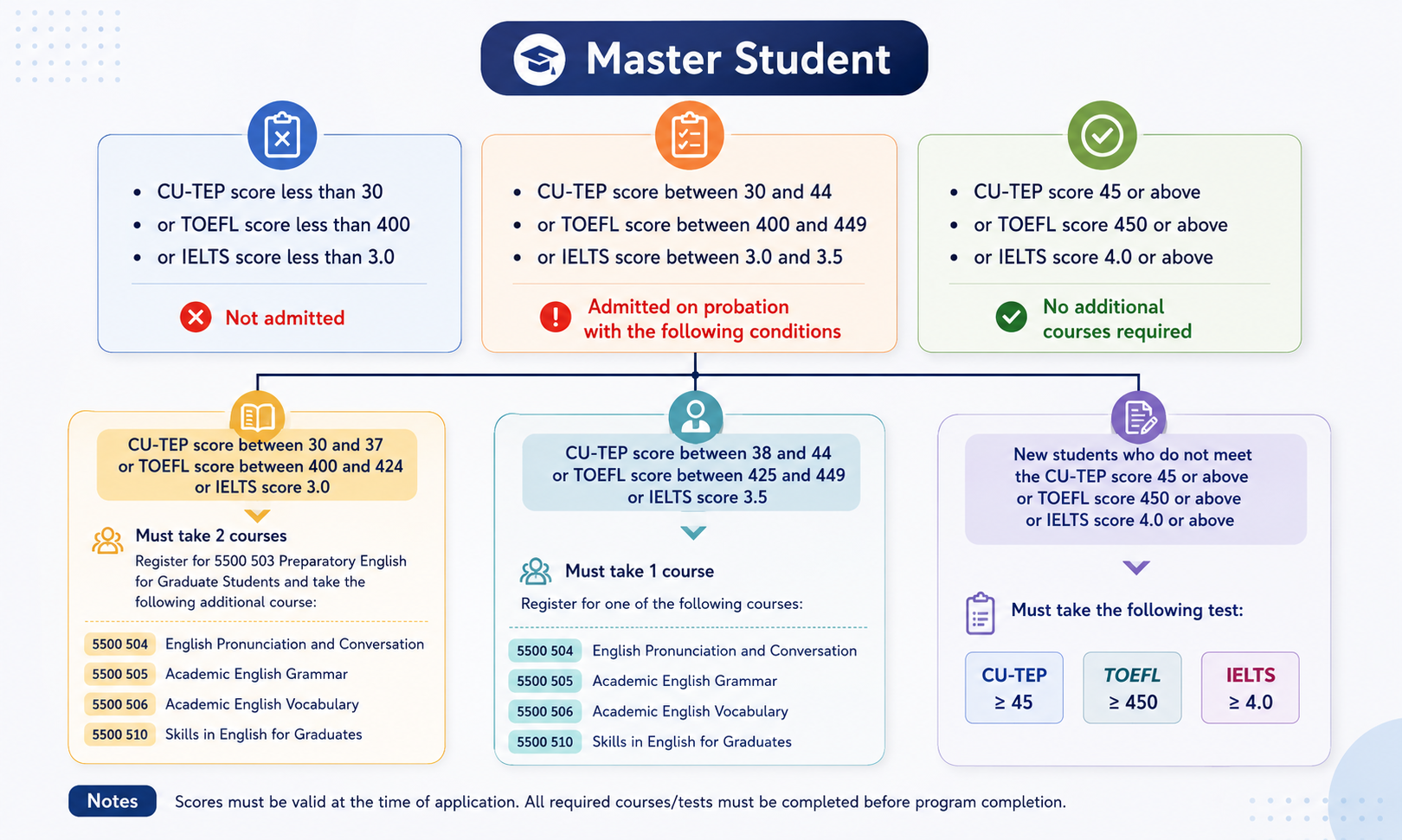
English Language Testing Guidelines for Master’s Students
 Course Registration
Students may register for no more than:
-
- 15 credits per regular semester
-
- 6 credits during the summer session
Course registration must comply with the regulations of Chulalongkorn University governing graduate education.
Student Support and Academic Advising
The program organizes an orientation for newly admitted students at the beginning of each academic year. The orientation provides essential information about the curriculum, academic requirements, university regulations, administrative procedures, research expectations, and available student support services.
Each student is assigned an appropriate thesis advisor based on the student’s research interests and area of specialization. Thesis advisors provide academic guidance throughout the research process, including research planning, data collection and analysis, thesis preparation, and the communication of research findings.
Career Opportunities
Graduates of the Master of Science Program in Earth Sciences may pursue careers as university lecturers, school teachers, academic specialists, researchers, environmental professionals, Earth science consultants, and technical specialists in public agencies, private companies, research institutions, and educational organizations.
Potential employers and professional fields include:
-
- Department of Mineral Resources
-
- Department of Marine and Coastal Resources
-
- Department of Water Resources
-
- Department of Groundwater Resources
-
- Electricity Generating Authority of Thailand
-
- Institute for the Promotion of Teaching Science and Technology
-
- Thai Meteorological Department
-
- Department of Royal Rainmaking and Agricultural Aviation
-
- Department of Mineral Fuels
-
- Petroleum and energy exploration and production organizations
-
- Environmental consulting and management organizations
-
- Natural hazard and disaster management agencies
-
- Research institutions and private-sector organizations related to Earth sciences,
natural resources, water resources, energy, and the environment
Contact Information
Associate Professor Dr. Thitiphan Assawincharoenkij
Department of Geology, Faculty of Science
Chulalongkorn University
Email: thitiphan.a@chula.ac.th
Telephone: +66 2 218 5442